


The Woman Who Mistook Her Body for a Garage
A field awareness perspective
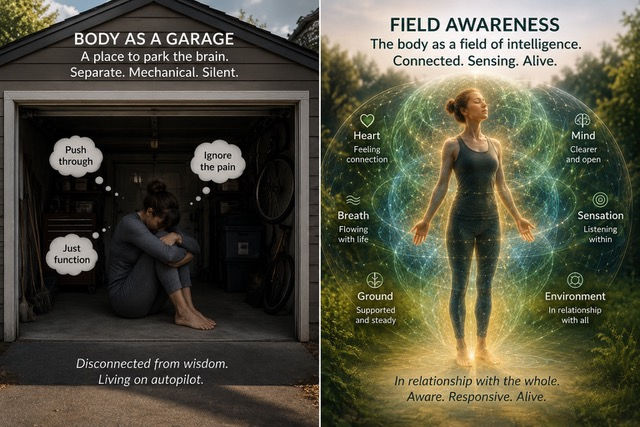
“My body? It’s just a garage for my brain,” a dear friend and colleague quipped years ago—and she meant it. I laughed, recognizing how often I inhabited that same field of perception.
Now I know better.
The body is not an empty structure in which to park anything. What we call brain, body, heart, and spirit are not separate parts—they are expressions of a single, dynamic field of living intelligence. To divide them is not just inaccurate—it limits what we can perceive and how we can live.
A Disruption in the Field
My awakening to this began in 1986, lying in a hospital bed in Berkeley, California.
After weeks of unrelenting pain—and futile attempts to keep working, ears ringing from too many aspirins—my family doctor asked a simple question:
“Will you let us help you?”
That question shifted the field.
For a brief moment, it interrupted the chaotic swirl of pain, fear, and mental overdrive. Something opened. I said yes—reluctantly.
After a noisy, excruciating MRI, the neurosurgeon offered a familiar solution: remove disks, fuse vertebrae, fix the problem. A mechanical intervention for what was assumed to be a mechanical issue.
But my family doctor, Michael Smith, sensed a larger field at play. “We need to understand what this is about on every level—physically, psychologically, emotionally, and spiritually.”
Again, the field shifted.
Was it possible that what I was experiencing was not a “part problem,” but a field phenomenon?
I understood this as an idea. I did not yet know how to perceive it.
Learning to Sense the Body as Field
I sought help across modalities—chiropractic, acupuncture, massage, meditation, movement. There was some relief, but it came and went. The underlying field remained largely unchanged.
Reluctantly, I tried one more approach: working with a Feldenkrais practitioner.
Something different happened.
As she placed her hands on me, she wasn’t “fixing” my body—she was listening to a field of sensation, pattern, and intelligence. Gradually, I began to do the same.
As she moved my limbs in unfamiliar ways, I noticed subtle internal shifts—sensations that felt like currents moving through a living system. My awareness expanded from thinking about my body to sensing within it.
Through what I later learned was called Functional Integration, new coherence began to emerge across the field—movement, sensation, thought, and emotion reorganizing together.
My body did not speak in words, but the message was unmistakable:
“Stop pushing me around.”
What I began to sense was not just a body—but a personal field.
From Personal Field to Interconnected Fields
Intrigued, I traveled to Oregon to study with Russell Delman at The Embodied Life™ School.
There, my awareness deepened.
I began to experience directly what I had only dimly intuited: that what we call brain, body, mind, and heart are not separate domains, but interwoven dimensions of a single field—and that this personal field is inseparable from larger relational fields.
It brought me back to something I had known as a child—running through the forests of the Berkshire Mountains, where the boundary between myself and the world felt permeable, alive, continuous.
I did not know then that this healing journey would become a path into what Alan Briskin and I now call field awareness—the capacity to perceive and consciously engage with the fields of energy and information shaping our lives.
False Dichotomies That Obscure the Field
What I encountered were not just physical symptoms, but the effects of deeply embedded assumptions—false dichotomies that fragment our awareness of the field.
False Dichotomy #1: The Brain and Body Are Separate
Many of us are conditioned to relate to the body as an object within our control—something to direct, manage, or override.
This reflects a limited perception of the field.
From a field awareness perspective, the brain is not the command center of an isolated system. It is one expression within an embodied, relational field of intelligence.
As philosopher Evan Thompson writes:
“The brain is always embodied…The physical substrate of mind is this embodied, embedded, and relational network, not the brain as an isolated system.”
To listen to the body, then, is not simply to attend to physical signals. It is to sense into a field of information and meaning that is continuously unfolding within us.
Practices such as embodied meditation (developed by Russell Delman), Focusing (developed by Eugene Gendlin), and the Feldenkrais Method (developed by Moshé Feldenkraise) help cultivate this sensitivity. They expand our capacity to perceive the internal dynamics of the field rather than imposing control upon it.
What practices help you sense and listen within your own field?
False Dichotomy #2: The Inner and Outer Are Separate
A second fragmentation occurs when we assume that what is “inside” us is fundamentally separate from what is “outside.”
Field awareness dissolves this boundary.
Alan Briskin and I define fields this way: A field is a space or territory in which networks of interactive forces—visible and invisible—radiate from sources inside and around us, influencing how we feel, think, and behave, often outside conscious awareness.
From this perspective, what we experience internally is inseparable from the larger fields in which we are embedded—social, cultural, environmental, and even historical.
We are in the field and of the field.
Although we speak of personal, social, and noetic fields to help perception, these are not separate domains. They are interpenetrating dimensions of one continuous field.
Russell Delman expresses this elegantly:
“We are separating what is intrinsically whole… We can’t know ourselves outside of the environment.”
Trying to understand ourselves apart from the field is like trying to understand lungs without air.
The Body as a Field-Sensing Organ
Our bodies are exquisitely attuned instruments for perceiving the field.
Yet most of us use them like weathervanes—only noticing when conditions become extreme: illness, stress, conflict.
With practice, they can become more like barometers—capable of sensing subtle shifts in the field before they fully manifest.
As a child, I lived in this awareness without naming it. When a thunderstorm approached in Massachusetts, I would spin in the grass, breathing in the charged air, feeling the rising intensity of the electric field.
There was no separation between inner sensation and outer environment. It was one continuous experience.
How might you begin to sense the continuity between your internal experience and the larger fields around you?
Living Into Field Awareness
Moving beyond these dichotomies is not easy. They are deeply embedded in how we have been taught to think—brain vs. body, inner vs. outer.
But as field awareness develops, something shifts.
We begin to perceive patterns we could not see before. We become aware of forces shaping our experience—within us and around us. And with that awareness comes the possibility of choice.
We can begin to participate more consciously in the fields we inhabit. We can sense what is life-giving and what is constricting. We can help cultivate conditions for greater coherence, connection, and creativity.
For me, this has been a gradual unfolding—one small shift in awareness at a time.
What was once a “garage” is now a living field of intelligence—a source of guidance, a medium of connection, a place where wholeness is not an idea, but an experience.
How might your body—your field—be inviting you into a deeper experience of wholeness?


Comments