


When a Sitcom Mentions “The Field,” I Notice
- Mar 24
- 4 min read
Updated: Apr 1
By Alan Briskin

When a fictional therapist starts talking about “the field” as an intelligent force shaping who we become, I notice.
Not because he gets it exactly right, but because the metaphor has entered the mainstream. In the opening episode of Season 3 of Shrinking, Harrison Ford’s character tells a skeptical patient:
“Life is a conversation with the universe… The field is an intelligent energy force that knows who you are supposed to be. And it’s going to keep demonstrating to you what it is you need to work on most—over and over again -- until you start to do it.”
Sean, the patient, rolls his eyes. Skeptical but curious, he replies, “That actually sounds like it would be very helpful… if it were real.” He looks at his therapist and asks, “Why are you smiling?”
Harrison Ford doubles down: “Because I’m just thinking about how much I’m going to enjoy it when you find out that the field is real. And when that happens, you don’t even have to tell me. Just… I don’t know… throw me some prayer hands like I’m a god.”
Sean grins: “How about I hit you with a sexy wink?”
Something is happening here before our eyes. A language once confined to physics, spirituality, and certain corners of psychology slips casually into prime-time entertainment.
From Empty Space to Living Context
For centuries, we imagined space as empty—a neutral backdrop in which events occur. Modern physics disrupted that assumption. Fields replaced emptiness. What we once thought was void turned out to be structured, dynamic, and alive with influence.
In our book Space Is Not Empty, Mary Gelinas and I extend this insight beyond physics. We suggest that human life unfolds within relational fields—patterns of energy and information that shape perception, emotion, behavior, and possibility.
We are not isolated individuals making decisions in a vacuum. We are participants in living contexts.
The show’s therapist captures something intuitive and compelling: life does seem to bring us the same lessons repeatedly. The same relational dynamics. The same blind spots. The same invitations to grow.
Anyone who has done therapy—or leadership work—knows this.
But here is where I would make a gentle distinction.
Is the Field a Teacher—or a Pattern?
In Shrinking, the field is described almost as a cosmic instructor with a lesson plan. It “knows who you are supposed to be” and keeps assigning homework until you comply.
That framing has appeal. It gives coherence to difficulty. It reassures us that struggle has meaning. Yet the language of destiny can subtly disempower.
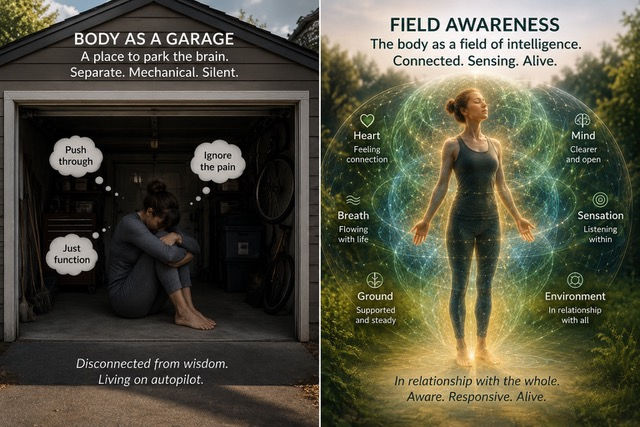
In our work, we describe fields not as fate, but as patterned relational environments.
A field does not impose a curriculum. It reflects participation.
If the same dynamic keeps appearing in your life, it is not because the universe is stubbornly teaching you a lesson. It may be because a pattern—internal, relational, systemic—is reasserting itself.
Fields are self-organizing. They gather around certain attractors: beliefs, emotions, histories, power dynamics, and unspoken agreements.
Until awareness shifts, the pattern persists. This does not require a cosmic intelligence directing traffic. It requires relational awareness and a willingness to mend what is fractured.
Life as Conversation
Playing the therapist, Harrison Ford says something I deeply appreciate:
“Life is a conversation with the universe.” That line comes very close to how I experience field awareness. A conversation implies mutual influence. It is not cosmic command, inescapable destiny, or random chaos. It is relational exchange.
In a conversation, what I say affects what you say next. What you say affects me. Over time, a pattern emerges—tone, rhythm, direction. Fields operate similarly.
Our thoughts, emotions, and actions contribute to the relational environment we inhabit. That environment, in turn, influences what feels possible to us.
When we are unaware, we experience this as repetition or fate.
When we become aware, we discover participation.
Why This Cultural Moment Matters
When a popular show can casually reference “the field,” something in the collective imagination has shifted.
The mechanistic worldview—where individuals are separate units navigating empty space—is loosening. Even comedy now gestures toward relational intelligence.
For decades, leadership and organizational development has focused on behavior, strategy, and skill. Those matter. But beneath every conversation and group process lie subtle currents shaping what becomes possible.
If a team feels anxious, no amount of technique overrides the field of anxiety.
If a relationship settles into defensiveness, logic alone won’t dissolve it.
If a culture normalizes mistrust, policy changes only go so far.
Field awareness invites a deeper question:
What is the relational environment we are co-creating?
And how might attention itself begin to shift it?
The Risk of Magical Thinking
There is a fine line here.
Field language can drift into mystification — into language that sounds profound but avoids accountability. If we attribute everything to an intelligent force with a hidden agenda, we sidestep reflection.
“I guess the universe wants this.”
Especially when things go badly, it is easy to slide into wishful thinking or resignation.
That is not what we are encouraging. Field awareness does not reduce agency — it expands it.
When we recognize that we are embedded in dynamic relational systems – in living contexts that shape and are shaped by us -- we stop trying to control outcomes directly and start influencing conditions.
Gardeners don’t force flowers open. They tend the soil.
Similarly, leaders, therapists, and change agents influence the quality of attention, safety, resonance, and coherence within a field. Over time, new patterns can emerge.
Not because fate decreed it.
But because participation shifted.
A Question for Reflection
If life truly is a conversation, what tone are you bringing to it?
If certain lessons keep repeating, what pattern might you be helping to sustain?
And what would it mean to consciously enter the conversation? Perhaps the field is not teaching us anything. Perhaps it is waiting for us to participate.


Comments